
Students' Evolutionary Mindset
4 Things All Learners Should Know About Their Evolved Brains and School

Mistakes help me learn.
I can’t do it…YET.
I can do hard things.
Every classroom teacher is familiar with ideas like these from Growth Mindset. Coined by Carol Dweck (2006), Growth Mindset teaches children that, rather than insurmountable obstacles, challenges are healthy and help us to learn and grow when we approach them with openness.
Growth Mindset encourages children to think about their abilities as something they can improve rather than a fixed characteristic of who they are. It promotes resilience and supports metacognitive practices in even the youngest learners.
Most of what I write about is directed towards teachers having an understanding of evolutionary educational psychology—but what if students did too? Just like understanding how the brain learns through effort and mindset, I believe that understanding some of the evolutionary roots of learning can help children develop resilience, motivation, and achieve success in and out of the classroom.
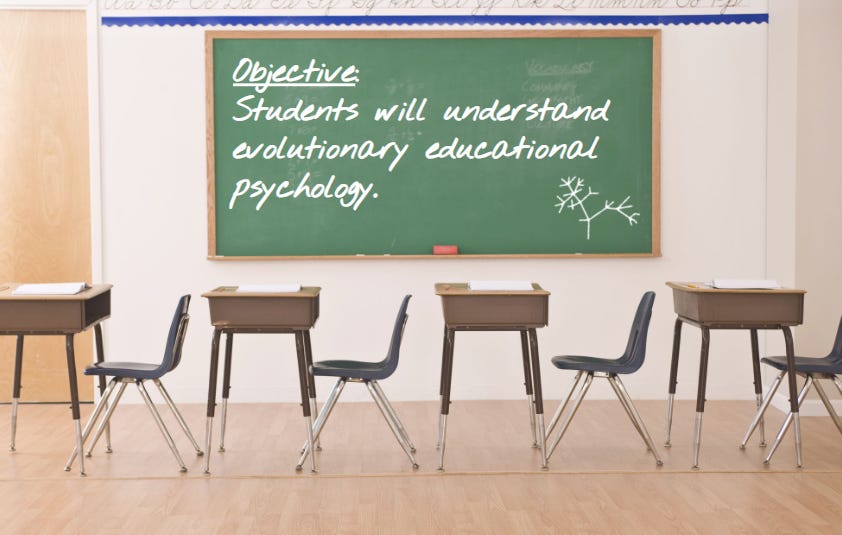
Below are four evolutionarily grounded ideas that can help to empower learners. We can refer to these ideas as an evolutionary mindset. While an evolutionary mindset is similar to Growth Mindset, it goes one step further by explaining why learning feels the way it does in modern school systems. Each is distilled down to a simple translation for use with even our youngest students. In all likelihood, all kids would benefit from this type of information!
Idea 1: Learning is often hard
Background for teachers and older students: Most similar to the ideas of growth mindset is the idea that much of modern learning is difficult due to our evolutionary history. The lion’s share of our species’ history prioritized the acquisition of primary knowledge (e.g., recognizing emotions, communicating effectively, understanding social dynamics, basic tool usage, etc.). While not simple skills by any means, primary skills are so interwoven with our ancestors’ survival and success that organic acquisition of these skills was selected for via natural selection and our cognitive architecture supports development of such skills without explicit instruction (Geary, 2024).
Secondary knowledge (e.g., literacy and numeracy) are much more novel in our evolutionary history and, as such, we do not have the cognitive structures to readily and organically acquire these skills. Instead, instruction and effortful work is required to develop these novel sets of skills. What kids are doing in school is effectively re-wiring their brains to acquire skills that our ancestors could never have imagined. That rewiring takes work, effort, and focus. Kids can be taught that they aren’t dumb or slow if learning is hard. With an understanding of our evolved learning mechanisms, difficulty is to be expected!
Translation for younger learners: School feels hard because your brain is learning to do things humans don’t learn naturally. If it feels difficult, that’s good! You’re building new brain connections!
Idea 2: Learning is social and collaborative
Background for teachers and older students: So often today we see individualized instruction prioritized over all else. In practice, that often means putting students behind computer screens to get targeted instruction from a web-based program or splitting children into ability groups for small-group instruction. However, these learning arrangements don’t allow children the opportunity to learn from one another. Teachers can provide scaffolds for their students, but that requires a strong knowledge of developmental trajectories and student abilities. It also requires extensive time.
During the majority of evolutionary history, mixed-age groups of children would naturally provide scaffolds for one another due to naturally having different abilities and strengths (Gray, 2013). Not only did this arrangement help with the development of skills for the more novice child, it would also have helped the more advanced child strengthen their own set of skills and develop social-emotional skills such as empathy or care-taking. While we shouldn’t remove the teacher from the equation, modern classrooms can still benefit from children working together and naturally supporting one another. Students can be taught that this type of work is critical.
Translation for younger learners: Everyone grows at different speeds and learning works best when everyone is working together. Just like it is important to listen to and learn from your teacher, you should also listen to and learn from your classmates.
Idea 3: Different developmental trajectories lead to different skills/strengths
Background for teachers and older students: Evolutionary developmental psychology argues that development is shaped by environmental conditions. Humans have evolved plasticity to respond to their environments in order to be successful. Someone who grows up under harsh or uncertain conditions will likely not develop the same strengths and abilities as someone with a more stable upbringing (Ellis et al., 2023).
In a school context, early life experiences shape the strengths and abilities of students in different ways. Schools historically value certain sets of skills (e.g., following directions, delaying gratification for long-term rewards, sustained attention). Yet, children from early adversity often develop different strengths that, while not traditionally valued in the school system, can be used to inform instructional methods to better fit the needs of diverse learners (e.g., task-shifting, recognizing emotions, greater attunement to ecological relevance; Murray & Schlomer, 2024).
Aside from informing teaching methods, these ideas can be used to empower students from different backgrounds. Early adversity and traditional deficit lenses can be replaced with strength-based labels (e.g., stress-adapted rather than at-risk; Murray et al., 2025). By teaching kids to be aware of their unique skills, and understand why other things may be more difficult, we can help them take ownership over their learning and not be discouraged by narrow school expectations.
Translation for younger learners: Your experiences shape who you are. But regardless of what those experiences are (easy or more difficult), you have unique talents and strengths that will help you be successful in life.
Idea 4: Education is not confined to the classroom
Background for teachers and older students: Lastly, it is important to recognize that under ancestral conditions, learning was primarily child-directed and happened organically in mixed-age groups of kids, not in schools (Gray, 2013). Schools, as we know them, are a fairly novel invention. Learning doesn’t just happen within the walls of the school. Learning happens through all activities and experiences. Engaging in sports, arts, drama, and play is just as important as engaging in the classroom.
Childhood evolved as a period of observation, mimicry, and play (Bjorklund, 2022). When we rob children of the opportunity to organically interact with adults and their peers in areas that surround their own interests, we take away a powerful driver of learning. With this in mind, teachers should spread a dual-sided message: Yes, school is important. Kids need it to acquire academic skills. But, academic skills are not all there is. Kids should also have the opportunity to play, explore, join sports and clubs, and overall just be kids. We often imagine that time for school means time for learning. Yet, learning does not stop at dismissal—and that is not just because of homework. All of childhood is really a time for learning.
Translation for younger learners: Everything you do is important for learning different skills. School, while important, is not all that matters. You are always learning and growing.
Takeaways
You will not find me in my classroom tomorrow teaching the ins-and-outs of human evolution. That’s not the point. Rather, an evolutionary mindset helps shape how students think about learning.
Modern school systems are markedly different from the ways in which our species has evolved to learn. There are some pretty compelling arguments that these differences are, to some degree, necessary. Yet, this mismatch often has the effect of making school feel hard and discouraging for many students. An evolutionary mindset helps students make sense of that experience. While Growth Mindset tells students they can improve, an evolutionary mindset helps them understand the school system and their role in it.
Overall, an evolutionary mindset helps students understand why learning often feels hard, why it works best with others, why we all develop differently, and why it doesn’t stop when the school day ends. While I don’t think we need explicit evolutionary psychology lessons in kindergarten, these simple evolutionarily informed ideas are powerful insights that can help support even our youngest learners.
References
Bjorklund, D.F. (2022). Children's evolved learning abilities and their implications for education. Continuing Education, 34, 2243-2273.
Dweck, C. S. (2006). Mindset: The new psychology of success. Random House.
Ellis, B.J., Abrams, L.S., Masten, A.S., Sternberg, R.J., Tottenham, N., & Frankenhuis, W.E. (2023). The hidden talents framework: Implications for science, policy, and practice. Cambridge University Press.
Geary, D. (2024) The evolved mind and modern education: Status of evolutionary educational psychology. Cambridge University Press.
Gray, P. (2013). Free to learn. New York, NY: Basic Books.
Murray, J., Gruskin, K., Hall, C., Sykes, I., Woodward, J., McCarthy, M., & Schlomer, G.L. (2025). Stress-adapted teachers pave the way for stress-adapted students: A potential benefit of in-group bias in K-12 educational contexts. Social Psychology of Education, 28, 199.
Murray, J., & Schlomer, G. L. (2024). In search of hidden talents: Stress-adapted students, classroom characteristics, and academic achievement. The Journal of the Evolutionary Studies Consortium, 14 (Sp. Iss. 1), 28-41.